

The short answer
Often yes. Body-line and aluminum-panel dents on an Audi are frequently repairable without paint, but they sit at the demanding end of PDR: the crease locks the metal in two directions and aluminum work-hardens as it is moved. What decides it is paint condition, how far the metal has stretched, whether the back of the panel can be reached, and whether anyone has already tried to pull it. A body-line dent should be assessed in person under reflection lighting.
 Written by the DentPicks Editorial Team
Technically reviewed by Vytas Kucinskas, Founder & Master PDR Technician
Written by the DentPicks Editorial Team
Technically reviewed by Vytas Kucinskas, Founder & Master PDR Technician
Published: Aug 19, 2026 · Last reviewed: Aug 19, 2026 · 9 min read
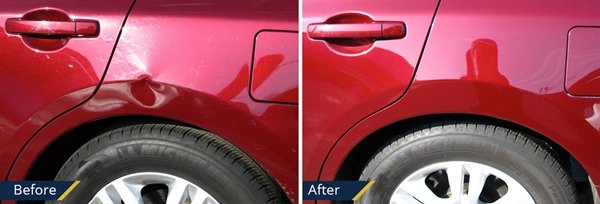
Audi built much of its design language around sharp, uninterrupted character lines — the crease that runs the length of a door, the shoulder line above the wheel arch, the tight radius where a fender meets a hood. Those lines are also the hardest place on the car to hide a dent, and the hardest place to repair one. Combine them with the aluminum panels Audi has used extensively for decades and you get the two questions this guide answers: can a dent on a body line be fixed without paint, and does aluminum change the answer?
In most cases the answer to both is yes, with conditions. The conditions are worth understanding before you approve anything, because a body-line dent is the one type where the difference between a good repair and a mediocre one is visible from across a parking lot.
Why a body line makes a dent harder
A flat panel is a single surface. Push it in and the metal stretches in a predictable bowl; release it correctly and it comes back. A body line is different. It is a fold — a deliberate bend that stiffens the panel and gives it its shape. When an impact lands on or across that fold, three things happen at once:
- The metal is locked in two directions. The fold resists movement along its length as well as across it, so the technician cannot simply release tension from one axis.
- The line itself deforms. A dent beside a crease pushes the crease off its true path. Getting the surface flat is only half the job; the line has to run straight again, and the eye reads a crooked line instantly.
- The stiffened metal has often stretched. Because the fold resists deformation, an impact that does deform it has usually worked the metal harder than the same impact on a flat area — which means less shape memory to work with.
That is why a shop should quote a body-line dent differently from a door ding of the same diameter. It is the same size and a different job. Our guide on deep creases and large dents goes further into where those limits sit.
Where the dent sits relative to the line
| Dent position | Typical difficulty | What usually decides it |
|---|---|---|
| Flat area, well away from the line | Standard | Access to the back of the panel |
| Near the line, not touching it | Moderate | Whether working the dent pulls the line off true |
| Directly on the line, shallow | Demanding but common | Access and how much the crease has stretched |
| Directly on the line, sharp or deep | Hardest case | Metal stretch — this is where paint sometimes wins |
| Across the line at an angle | Hardest case | Two-axis lock plus a distorted line path |
| Where two lines meet | Case by case | Almost always needs an in-person read |
None of these are automatic refusals. Plenty of body-line dents come out completely. But the honest range of outcomes is wider here than anywhere else on the car, and any shop should tell you that before starting rather than after.
What aluminum adds
Audi has used aluminum panels and aluminum-intensive structures across a broad range of models, though which specific panels are aluminum on any given car depends on the model, the model year and the configuration. A magnet and a paint-thickness gauge confirm it in a couple of minutes; nobody should be guessing over the phone.
Where the panel is aluminum, three practical differences show up:
- Less shape memory. Steel largely wants to return to where it was. Aluminum has to be walked back deliberately, in more and smaller movements.
- Work hardening. The metal gets stiffer as it is moved, so there is a finite budget of corrections before it stops cooperating. That is why an experienced technician plans the sequence rather than improvising.
- Different tooling and often controlled heat. The pressure profile, tip selection and use of heat are not interchangeable with steel technique.
Add a body line to an aluminum panel and you have the most demanding combination in routine PDR work. It is still frequently repairable — it simply takes hours rather than minutes, and the assessment has to be honest. Our guide on what makes aluminum a specialty covers the metal side in more detail.
How the repair is actually approached
At our Plano shop a body-line Audi dent is read before it is touched. The panel goes under line boards so the reflection shows precisely where the crease deviates. Paint thickness is measured across the area — that tells us whether the finish is factory or a previous respray, and whether filler from an old repair is hiding under the surface. Both change the plan; original factory paint flexes predictably, and a resprayed panel does not.
Then access gets mapped. On a door that usually means dropping the interior trim panel, which is done to the manufacturer's documented procedure: wiring harnesses protected and routed back as designed, side-curtain airbag components left undisturbed, clips and fasteners reinstalled as specified. If a camera, radar or ultrasonic sensor is disturbed in the process, whether the vehicle needs calibration afterward is determined by the manufacturer's procedure for that exact car — manufacturer procedures vary by model year and configuration, and NHTSA is a useful starting point if you want general background on how these safety systems work.
The repair itself works the surrounding surface before the line, then brings the crease back in small increments, checking the reflection continuously. We do not drill access holes — a new opening in a warranted aluminum panel is an avoidable corrosion path. When it is finished, the job is signed off by whoever runs quality control, and that sign-off is visible in your customer portal.
When paint is the better answer
Panels sometimes do need refinishing, and pretending otherwise is how owners end up disappointed. The usual triggers on an Audi body-line dent:
- The paint has cracked or chipped along the crease — the coating problem has to be solved regardless of what the metal does.
- The metal is measurably stretched. A PDR rod moves metal; it does not remove surface area that has been added.
- Someone already tried to pull it. A previous attempt with a suction cup or glue puller frequently doubles the damage, and the reasons are in our guide on why DIY dent methods fail.
- The back of the panel genuinely cannot be reached — bonded seams, structural adhesive or a one-piece inner frame with no route in.
We do what is best for the vehicle rather than forcing every dent through one method, and the recommendation comes before the work starts, not halfway through.
Common mistakes
- Judging the result in a garage. Body-line repairs have to be inspected under a reflection source, at an angle, along the length of the line — not straight on under a ceiling light.
- Accepting "100% guaranteed" on a crease. Nobody can promise that before reading the panel properly.
- Comparing prices without comparing the dent. A body-line dent and a flat-panel ding of the same size are different jobs; a quote that treats them identically has not been assessed.
- Waiting through a Texas summer with cracked paint on the crease. Intact paint over a dent is stable; broken paint is not. Our guide on what Texas heat does to unrepaired dents explains why.
- Letting a driveway crew try it after a storm. Aluminum and body lines are exactly where a rushed pull does lasting damage.
What to do next
For a body-line dent, photographs help but rarely settle it. Send three anyway — straight on, at a low angle so the reflection runs along the crease, and one wide shot — and you will get a verbal read quickly. Then bring the car to the Plano shop so the line can be assessed under proper lighting before anyone commits to a method or a price.
You will get a realistic range of outcomes, including the case where the panel needs paint. Repairs carry a written lifetime warranty for as long as you own the vehicle, not transferable. See finished work in our before and after gallery or read more about our dent repair service in Plano.
Frequently asked questions
Why does a small dent on a body line cost more than a bigger one on a flat panel?
Because it is a harder job, not a bigger one. The crease resists movement along its length as well as across it, the line itself has to be brought back to true, and the stiffened metal usually stretched more on impact. Pricing follows labor hours, not dent diameter.
How can I tell if my Audi's panel is aluminum?
A magnet will not stick to it, and a paint-thickness gauge reading combined with the manufacturer's documentation confirms it. Which panels are aluminum varies by model, model year and configuration, so it is checked at the shop rather than assumed.
Will a repaired body line be visible later?
A properly finished body-line repair reads straight under reflection lighting from any angle. Where a shop stopped short, you will see the line waver as you walk past it. That is exactly why the result should be inspected under a reflection source before you take the car.
Can hail dents on an Audi roof or hood be fixed without paint?
Usually, yes — hail lands mostly on flat horizontal surfaces where PDR works best, and intact paint keeps the panel a clean candidate. Aluminum hoods take longer per dent than steel ones. Repairability still depends on paint condition, metal stretch, panel access and prior repairs.
Does removing the door trim to reach a dent risk the airbags or wiring?
Not when the work follows the manufacturer's documented procedure: harnesses protected and rerouted as designed, side-curtain airbag components left alone, and fasteners reinstalled as specified. If a sensor is disturbed, the manufacturer's procedure for your vehicle determines whether calibration is needed.
Is it worth repairing a body-line dent before selling or trading the car?
Usually. A crooked character line is one of the first things an appraiser notices, and reconditioning deductions are taken at retail rates. A PDR repair that leaves the factory paint intact also avoids creating any paint history on the car.
Sources and methodology
- Vehicle safety information — National Highway Traffic Safety Administration.
Repair, cost and timing statements that are not tied to a listed source come from DentPicks' own quoting and repair history at the Plano, TX shop. They are typical ranges and shop-floor observations, not industry statistics or promises — your vehicle, its condition, your policy language and your insurer determine your specific outcome.
Have a dent on an Audi character line?
Send photos for a first read, then bring the car to the Plano shop so the line can be assessed under reflection lighting. You will hear the realistic range of outcomes before anything starts.