The short answer
Usually yes, if the damage is in an outer skin. Hoods, roofs, doors, fenders and quarter panels use formable steels that respond to paintless work, though thinner, higher-strength skins spring back more and need smaller increments and more passes. Structural high-strength members such as pillars, rails and rockers are outside paintless repair entirely. Stretched metal and broken paint remain the real limits, not the steel grade.
 Written by the DentPicks Editorial Team
Technically reviewed by Vytas Kucinskas, Founder & Master PDR Technician
Written by the DentPicks Editorial Team
Technically reviewed by Vytas Kucinskas, Founder & Master PDR Technician
Published: Aug 19, 2026 · Last reviewed: Aug 19, 2026 · 9 min read
"High-strength steel" appears in almost every manufacturer's safety marketing, and it makes people assume their car is now made of something unrepairable. The reality is more useful than that. Modern vehicles use several different steels in different places, chosen for what each part has to do, and where a given grade sits on the car tells you almost everything about whether a dent in it can be pushed back out.
The short version: the strongest steels on a car are usually in the parts you cannot see, and those parts are not paintless-repair territory at all. The parts you can see — the outer skins — are made of steel chosen to be formable, and that steel is repairable. But it is thinner than it used to be, and thinner changes technique.
Where the strong steel actually lives
Body engineering separates two jobs. Structure has to manage crash energy; skin has to look good and resist small damage. The materials follow the jobs:
- Structural members — B-pillars, roof rails, rocker reinforcements, front and rear rails, bumper beams. These use the highest-strength grades, including press-hardened steels. They are not accessible, they are not cosmetic, and they are governed by manufacturer repair procedures that often prohibit heating, straightening or sectioning outside defined limits. Damage there is a structural repair question for a body shop, full stop.
- Outer skins — hood, roof, doors, fenders, quarter panels. These use formable steels: mild steel, and increasingly bake-hardenable grades that are soft while being pressed at the factory and gain strength during the paint bake. Some skins use higher-strength grades to allow a thinner gauge without denting too easily.
This is why the honest answer to "can PDR fix high-strength steel panels?" is a question in return: which panel? If the dent is in a skin, the conversation is normal. If the damage reached a structural member, no paintless technique is the right answer, and any shop suggesting otherwise is worth walking away from.
What thinner, stronger skin steel does to the repair
Higher-strength skin steel is not "harder to fix" in a mysterious way. It behaves differently in three specific and predictable ways, and technique adjusts.
| Property | What it means at the panel | How technique changes |
|---|---|---|
| Higher yield strength | More force needed before the metal moves at all | More controlled pressure, better leverage, no jabbing |
| More springback | The metal pushes back after the tool releases; a push that looked right relaxes | Smaller increments, more passes, constant re-reading |
| Thinner gauge | Less material to absorb a mistake; easier to overshoot into a high spot | Work below the point of correction and creep up on it |
| Less ductility than mild steel | Less tolerance for repeated working of the same spot | Fewer, better-placed pushes rather than many rough ones |
| Bake-hardened after paint | The panel on your car is stiffer than the blank that was pressed | Expect a slower, more patient repair than an older vehicle of the same size |
The practical consequence for a customer is time, not impossibility. A hail-damaged hood on a newer vehicle with thin, higher-strength skin generally takes longer per dent than the same hood on a fifteen-year-old car. It also punishes a hurried technician: springback means the difference between a finished panel and a panel with fifty tiny high spots is patience.
Why stretch is the real limit, not strength
The thing that ends a paintless repair is not how strong the steel is. It is whether the impact permanently increased the surface area of the panel — stretched metal. Once there is more material than there is space for, straightening produces fullness, a soft oil-can effect, or a low that will not stay up.
Thin, high-strength skins reach that point sooner than thick mild steel does, because there is less material to redistribute. That is the honest downside of modern lightweight construction: a shallow hail dent behaves beautifully, and a hard, sharp impact goes past the point of no return faster. Our guide on how paintless dent repair works explains the elastic behaviour the whole technique depends on.
Coatings on modern steel panels
Modern skin steel is usually galvanized or otherwise coated for corrosion protection, then primed, painted and clear-coated. That layered system matters in two directions.
In your favour: an intact coating system is the reason a dent with unbroken paint is stable and can be repaired years later without corrosion having taken hold. Against you: once the paint is broken at the low point of a dent, the exposed area is a real corrosion path, and North Texas humidity plus daily heat cycling works at the edges of damaged coating. This is why we treat broken paint inside a dent as a different category of damage from an intact dent, regardless of how strong the steel is — the point we make in our guide on what Texas heat does to unrepaired dents.
When paintless repair is the wrong tool on steel panels
- Any damage to a structural member. Pillars, rails, rockers and reinforcements are outside paintless repair entirely, and manufacturer procedures for high-strength structural steels vary by model year and configuration.
- Sharp creases in thin skin steel. A folded crease in a thin, high-strength panel is where springback and limited ductility work hardest against you. Some come out; many do not. See our guide on deep creases and large dents.
- Stretched metal. The genuine end of the line.
- Broken paint at the low point, which needs a coating fix whatever happens to the metal.
- Panels with filler already in them. Filler will not move with the steel and cracks or lifts when the metal returns.
Panels sometimes do need refinishing or replacement, and that is not a failure of the technique — it is the technique being applied honestly. We do what is best for the vehicle, and our comparison of PDR and a traditional body shop sets out how that decision gets made.
What this looks like on a hail claim
On a newer vehicle with thin, high-strength skins, hail damage often produces a large number of small, shallow dents rather than a few big ones. That is the good news: shallow damage in formable skin steel is exactly what paintless repair is for. The estimate reflects dent count and panel count rather than the steel grade, and adjusters are used to that.
Timing at our Plano shop follows the same pattern as any full-vehicle hail job — typically about 5–10 business days in the shop, sometimes toward the longer end on newer vehicles simply because each dent takes more passes. While the car is with us you get live updates, and the finished vehicle is signed off by whoever runs quality control, visible in your customer portal. On insurance-approved hail claims we arrange complimentary pickup across DFW and waive the deductible up to $1,000 on many approved claims. You file the claim; we walk alongside you through photos, the adjuster meeting, supplements and paperwork.
Common mistakes and red flags
- Assuming "high-strength steel" means unrepairable. It usually just means slower.
- Assuming your outer panels are the strong stuff. Skins are chosen for formability; the high grades are in the structure.
- A shop that promises a fixed number of dents per hour. On thin modern skin, promising speed is promising high spots.
- Any suggestion of heating and hammering a structural member back into shape. That is a manufacturer-procedure question, not a shop-preference question.
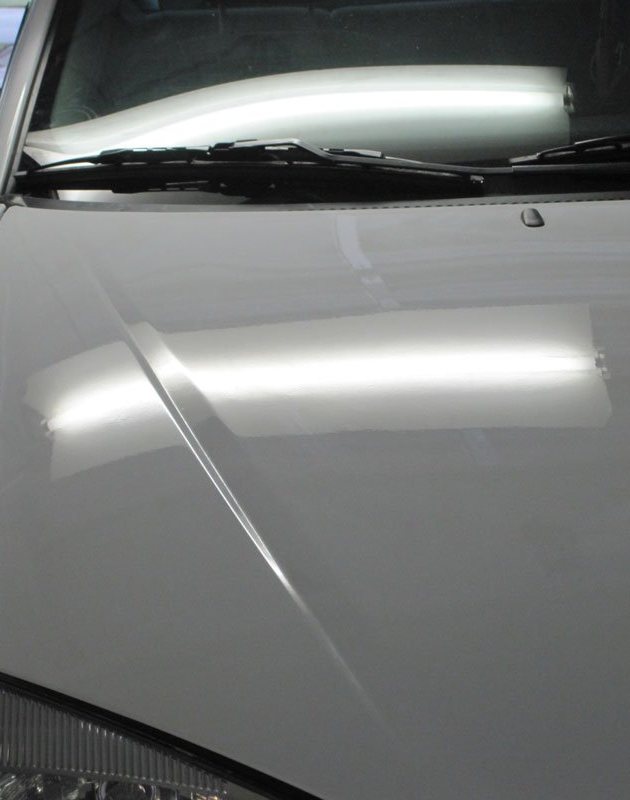
- Judging the result in a dim bay. Springback shows up as subtle waviness that only appears under a proper reflection, so look at the finished panel outside, from several angles, with something straight reflecting across it.
What to do next
Do not try to identify the steel grade in your panels — it is not published in a form that helps you and it is not the deciding factor anyway. What decides the repair is the shape of the damage, the condition of the paint and whether the metal has been stretched, and all three are settled by reading the panel under proper lighting.
Send low-angle photos with a straight reflection across the damage for a verbal quote, usually in about 30 minutes, or bring the car to the shop for a free inspection under PDR lighting. You can see finished panels in our before and after gallery, or read how dent repair in Plano runs from inspection to delivery. Repairability depends on paint condition, metal stretch, panel access and prior repairs.
Frequently asked questions
How do I find out what steel my panels are made of?
You generally cannot, and you do not need to. Grade information is published for repairers in manufacturer procedures rather than owner documents, and it is not what decides the repair. Damage shape, paint condition and whether the metal has been stretched decide it, and all three are read on the panel itself.
Does high-strength steel mean the repair takes longer?
Often yes. Higher-strength thin skin springs back after each push, so a technician works in smaller increments and re-reads the surface constantly. The same hail damage that takes a day on an older vehicle can take noticeably longer on a newer one. It is a patience problem rather than an impossibility problem.
Can a dent in a B-pillar or rocker be pushed out?
No. Those are structural members built from the highest-strength grades and governed by manufacturer repair procedures that often restrict heating, straightening or sectioning. Damage there is a structural repair question for a body shop. Any shop offering to pop a pillar dent out is not one to hand your car to.
What is springback and why does it matter?
Springback is the metal pushing back after the tool releases, so a push that looked correct relaxes a moment later. Higher-strength steels do it more. It is the main reason a repair on a modern panel is done in many small passes rather than a few decisive ones, and the reason a rushed job leaves a wavy surface.
Is a modern car more likely to dent than an older one?
Thinner panels can deform more readily from a light impact, which is one reason parking-lot dings are so common on new vehicles. The upside is that shallow, formable skin damage is precisely what paintless repair handles best. The trade-off is that a hard, sharp impact reaches stretched metal sooner.
Does galvanized coating affect a paintless repair?
Not the metal work itself. The coating system matters because an intact one is why a dent with unbroken paint stays stable for years. Once the paint is broken at the low point, the exposed area becomes a corrosion path, and Texas humidity and daily heat cycling work at the edges of damaged coating.
Sources and methodology
- After hail or windstorms: consumer tips — Texas Department of Insurance.
Repair, cost and timing statements that are not tied to a listed source come from DentPicks' own quoting and repair history at the Plano, TX shop. They are typical ranges and shop-floor observations, not industry statistics or promises — your vehicle, its condition, your policy language and your insurer determine your specific outcome.
Let the panel answer the question
Steel grade is not something you can check in the driveway. Bring the car to the Plano shop for a free read under PDR lighting and we will tell you what the damage actually is.