

The short answer
Yes, and it is the normal case. Most hail dents leave the paint completely intact because thin sheet metal yields and the flexible paint layers stretch with it. The damage is the displaced metal, and it is payable, repairable and deducted at appraisal regardless of paint condition. Intact paint makes paintless dent repair likely rather than certain — metal stretch, panel access and any prior refinishing still decide the method. Have the panels read under proper lighting before drawing conclusions.
 Written by the DentPicks Editorial Team
Technically reviewed by Vytas Kucinskas, Founder & Master PDR Technician
Written by the DentPicks Editorial Team
Technically reviewed by Vytas Kucinskas, Founder & Master PDR Technician
Published: Aug 19, 2026 · Last reviewed: Aug 19, 2026 · 10 min read
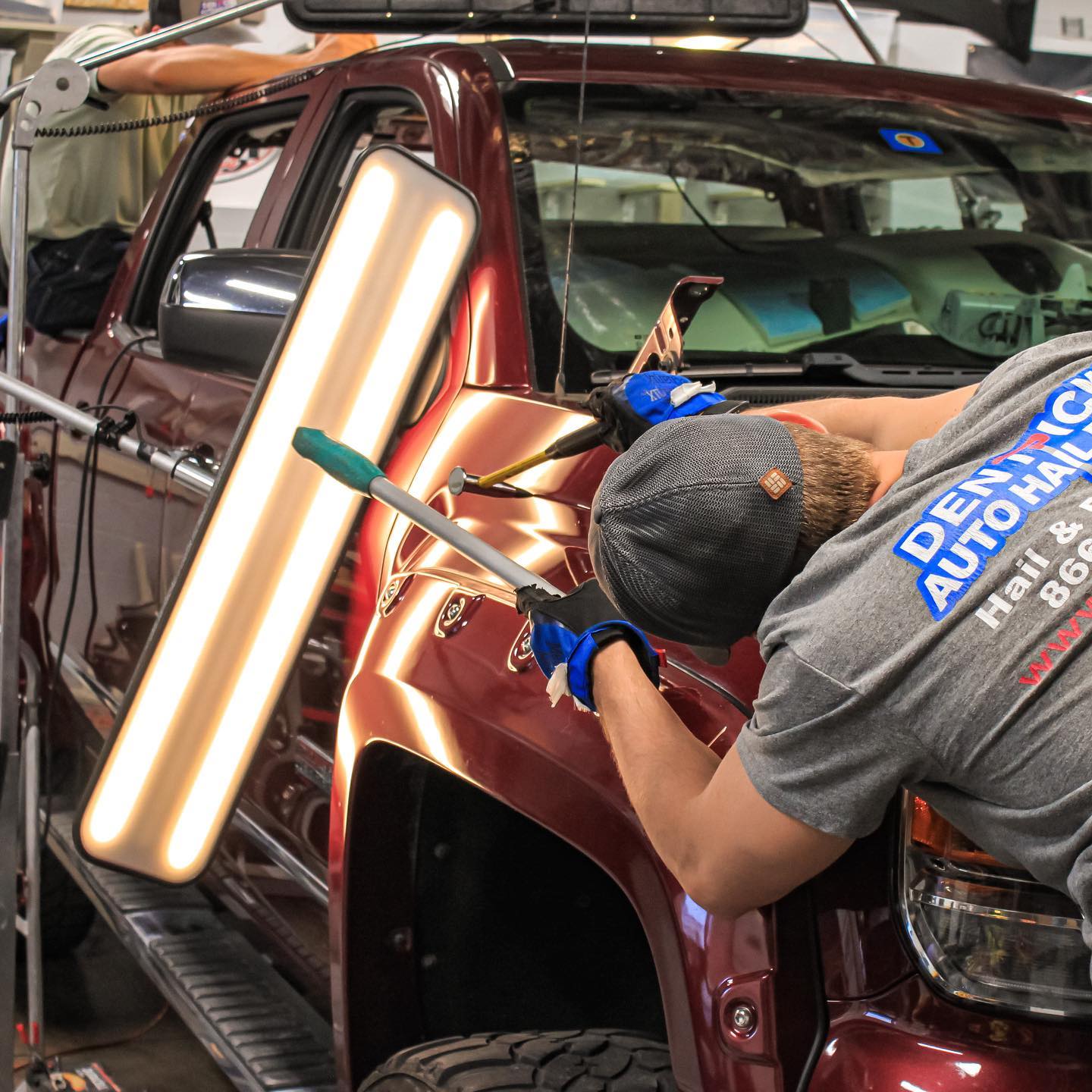
Yes — and it is the normal case, not the exception. Most hail damage on a modern vehicle leaves the factory finish completely unbroken. Ice deforms sheet metal without necessarily cutting the coating on top of it, so a hood can carry two hundred dents and still show no cracks, no chips and no exposed primer anywhere.
This confuses a lot of owners, because "the paint is fine" sounds like "the car is fine." What it actually means is that the damage is confined to the shape of the panel rather than its protection. That is good news for the repair — it is exactly the condition paintless dent repair is designed for — but it is not a reason to treat the damage as nothing.
Why paint usually survives hail
Automotive finish is a layered system: electrocoat primer, a color basecoat, and a clearcoat on top, all of it flexible enough to move with the panel. Sheet metal is thin and yields easily. When a hailstone lands, the steel or aluminum dishes inward and the paint layers stretch with it rather than shearing.
Whether the finish survives depends on a handful of things: the size and density of the stone, its terminal velocity and angle, the temperature of the panel, the age and flexibility of the clearcoat, and how well supported the metal is at that spot. Small to moderate hail on a warm, well-maintained panel almost always leaves the coating intact. Very large or jagged stones, or an older finish that has lost flexibility to years of North Texas sun, is where chips and cracks start appearing.
What unbroken paint does and does not tell you
| Question | Answer when paint is intact |
|---|---|
| Is the vehicle damaged? | Yes. The metal is displaced. Displacement is the damage. |
| Is it payable under a comprehensive claim? | Generally yes. Hail estimates are built from dent count and size, not from paint condition. |
| Is it repairable without repainting? | Usually — this is the ideal condition for PDR, though it depends on access and metal stretch. |
| Does it get worse over time? | Not the dent itself. A dent with intact paint is stable. |
| Does it affect resale? | Yes. Appraisers decondition visible hail regardless of paint condition. |
| Is it safe to drive? | Normally yes, assuming glass, lamps, mirrors and seals came through intact. |
The last two rows are where owners lose money by waiting. A dent with unbroken paint will not rust and will not spread, so there is no emergency — but it will still be deducted at retail rates when the car is appraised, and it will still be on the estimate an insurer would have paid for.
The damage you cannot see from the driveway
A hailstorm that does not crack paint can still do things that are not visible from ten feet away. The list worth walking after any significant storm:
- Glass chips. A windshield chip that looks trivial in the driveway runs into a full crack with the first cold morning. On many vehicles the forward-facing camera for lane keeping and automatic emergency braking mounts to the windshield, so glass damage in that area can become a driver-assistance issue rather than a cosmetic one.
- Lamp lens fractures. Hairline cracks in headlamp or tail lamp lenses break the seal and let moisture into the housing. Condensation appearing days later is the usual tell.
- Lifted trim and weatherstripping. Roof-rail trim, A-pillar moldings and window seals that no longer sit flush are water paths, and water damage costs far more than dents.
- Sunroof and roof-drain issues. A dented roof skin can distort the drain path around a sunroof opening.
- Sensor and camera housings. Radar and camera modules mounted in the grille, mirrors or rear hatch can be knocked out of alignment even without visible damage to the housing. Manufacturer procedures for checking and recalibrating vary by model year and configuration.
- Aluminum panels behaving differently. Many hoods, and on some vehicles entire bodies, are aluminum. Aluminum work-hardens and holds a dent more stubbornly than steel, which changes the repair approach even when the paint is perfect — our guide on aluminum dent repair covers why.
When intact paint does become a problem
Two situations turn an unbroken finish into a repair complication rather than a bonus.
The first is metal stretch. A deep enough impact thins the metal at the low point of the dent. The paint has not cracked, but the panel has been stretched, and a stretched panel will not simply return to shape — it has to be worked down carefully, and in some cases it cannot be brought fully flush without refinishing. This is a judgement call made under lighting on the actual panel, not from a photo. Our guide on deep creases and large dents goes into where that line sits.
The second is an older or previously repaired finish. A repainted panel, a panel with filler underneath, or a clearcoat that has been baking in Texas sun for a decade has less flexibility. Pushing a dent out from behind can crack a brittle aftermarket finish that would have survived on a factory panel. That is why prior repair history is one of the first things worth disclosing at an inspection.
Why you need lighting to see any of this
A hail dent with unbroken paint is close to invisible in ordinary conditions, and that is not a matter of how carefully you look. The dent is shallow and wide, with no shadow line and no color change. Your eye registers it only through the distortion it puts in a reflection, and diffuse outdoor light gives the surface almost nothing to reflect.
In the shop, panels are read under LED line boards — parallel bright lines projected across the surface at a shallow angle. Every deformation bends a line. Dents that were invisible in a parking lot become countable, their diameter becomes measurable, and you can see whether the low point has been stretched.
Intact paint is the reason the damage is repairable and the reason you cannot see it. Both come from the same fact: nothing was broken, only moved.
This is also the practical difference between a photo quote and an in-person inspection. Photos are enough to tell you whether you have a real hail event and roughly what scale of claim it is — that verbal figure usually comes back in about 30 minutes. The written estimate follows the in-person read, because dent count per panel is what a hail estimate is built from, and photographs of an unbroken finish systematically undercount it.
The storm record versus the panel
If you are trying to establish that a storm caused the damage, keep the two exercises separate. The NOAA Storm Prediction Center severe weather reports and the NWS Fort Worth/Dallas office confirm that hail was reported in an area on a date and roughly what size. Radar-derived hail swath maps go further and estimate probable hail size over a grid — but they are modelled products, not measurements of your driveway. Neither can tell you how many dents are on your hood. The inspection does that, and on a car with intact paint the inspection is the only thing that can.
What to check yourself after a storm
- Rinse the car so road film is not scattering the reflection.
- Sight along the roof, hood and decklid at a low angle in early or late sun, eye almost level with the panel.
- Run a hand over each panel. On intact paint your fingertips often find what your eyes miss.
- Walk the glass, lamps, mirrors and seals — the parts of a hailstorm that are genuinely safety items.
- Photograph every panel wide and close, and note the storm date.
- Report to your insurer promptly, even if you have not decided whether to repair.
Common mistakes
- "No cracks, no claim." Paint condition is not what a hail estimate is built from.
- Waiting because it is not getting worse. True for the metal, false for the appraisal deduction and false for the claim deadline.
- Trying a DIY suction puller or heat trick. These stretch metal and crack the very finish that was intact — see our guide on why DIY dent repair does not work.
- Buffing the panel before an inspection. Polishing does nothing for a dent and can fill the low points with residue, making the read harder.
What to do next
Treat intact paint as good news about the repair, not as evidence there is nothing to repair. Photograph the vehicle, confirm the storm date, notify your insurer, and get the panels read under proper lighting before deciding anything.
At DentPicks in Plano the inspection is free and the panel read happens under PDR lighting, not in the lot. Finished work is signed off by whoever runs quality control and visible in your customer portal, the repair carries a written lifetime warranty for as long as you own the vehicle — not transferable — and on approved hail claims we waive the deductible up to $1,000. See how the process runs on our hail repair page, or read how paintless dent repair works on a panel with unbroken paint.
Frequently asked questions
Will hail dents with intact paint rust?
No. Rust needs exposed metal, and an unbroken finish is still doing its job. A dent with intact paint is stable and can be repaired years later. Dents with chipped or cracked paint are the ones that genuinely get worse in Texas heat and humidity.
Will my insurer pay for dents if nothing is cracked?
Generally yes. A hail estimate is built from dent count and dent size per panel, not from paint condition. Coverage depends on the language of your policy, and your insurer or licensed agent can confirm your specific coverage.
Can paintless dent repair fix every dent that has intact paint?
Not every one. Repairability depends on paint condition, metal stretch, panel access and prior repairs. Deep impacts thin the metal at the low point, and some panels genuinely do need replacement and refinishing. We do what is best for the vehicle rather than forcing one method.
Why can the shop see dents that I cannot?
Because shallow dents produce no shadow and no color change — you only see them through the distortion they put in a reflection. Under LED line boards, parallel bright lines projected across the panel bend at every dent, which is why counts from a lit bay are far higher than counts from a driveway.
Does hail with unbroken paint show on a Carfax report?
Paintless dent repair itself creates no record. What can be reported is an adjuster-required panel replacement, if the damage on a given panel is severe enough that replacement and refinishing is the correct call.
Should I wash or polish the car before an inspection?
A rinse or basic wash helps, because road film scatters the reflection lines. Skip polishing — it does nothing for a dent and can leave residue in the low points that makes the read harder. If any paint is chipped, avoid pressure washing the broken edges.
Is it worth claiming if nothing is cracked and the car drives fine?
Often, yes — visible hail is deconditioned at retail rates when a vehicle is appraised, traded or sold, which usually costs more than the repair would have. Compare the panel count against your deductible before deciding, and check the reporting deadline in Texas.
Sources and methodology
- Severe weather storm reports — NOAA Storm Prediction Center.
- NWS Fort Worth/Dallas forecast office — National Weather Service.
- Automobile insurance guide — Texas Department of Insurance.
Repair, cost and timing statements that are not tied to a listed source come from DentPicks' own quoting and repair history at the Plano, TX shop. They are typical ranges and shop-floor observations, not industry statistics or promises — your vehicle, its condition, your policy language and your insurer determine your specific outcome.
Paint looks perfect but something feels off?
Send photos for a verbal figure, usually back in about 30 minutes, or bring the car to Plano and we will read the panels under lighting that actually shows what is there.